Organization
Training Organization
The Master’s program is organized into 4 semesters (S1 through S4) and structured around required or elective course units TU ). Each TU a credit value (ECTS). Each semester is worth 30 ECTS. The Master’s degree is awarded upon completion of 120 ECTS.
Prologue
Due to the high degree of heterogeneity among the recruited student body, the first-year program begins fifteen days earlier than theM2 program. These two weeks are then used to introduce students to the basic skills that will be expected to have been mastered by the time they begin the specialized coursework. Although not associated with any ECTS credits,the introductory courses in Mathematics, Electronics, Biology, and Health are mandatory and allow students to assess their own readiness in light of the requirements that will be expected of them later on. For example, the introductory course in Mathematics focuses on three main topics—complex numbers, linear algebra, and analysis (differentiation, integration, and differential equations)—which will find their respective applications in specific courses on Sensors and Robotics.
M1: First year of the master's program
- S1: First Semester
Due to the diversity of academic backgrounds among students admitted to the first year of the TecSan specialization, two specific tracks are offered. The first track allows students with a foundational background in electronics to build on their knowledge through certain course units taken in conjunction with the EEA Master’s program (https://www.eea.univ-montp2.fr). These include, in particular, the course units “Analog Electronics” and “Signal Acquisition and Processing.” Courses with similar content but adapted teaching methods are offered to students coming from the Biology and Health tracks. Supplemented by a module titled “Mathematics / Statistics / Data Analysis,” these course units form the first scientific component of the program. This component is complemented by health-specific courses offered to the entire cohort at the Montpellier Faculty of Medicine. These include the following course units: “Health Structures and Issues” and “Applications of ICT in HEALTH.” The latter course takes the form of lectures and discussions held every Tuesday evening and led by national healthcare professionals. Videos of these sessions are available on the program’s website (https://www.telecom-montpellier.fr). - S2: Second Semester
The second semester is also the last one in which the class is divided into specific tracks, allowing for a differentiated approach to the concepts of Imaging, Sensors, and Robotics.
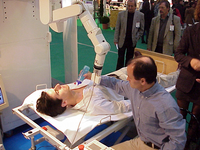
Medical RoboticsPhilippe Poignet
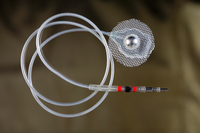
Epimysial electrode (copyright SUAWproject), D. Guiraud
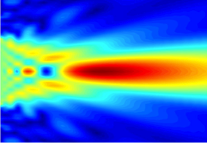
Emission from an, E. Le Clézio
Students are then offered the opportunity to specialize through two elective courses in “Medical Robotics,” “Neuroprosthetics,” or “Sensors for Medical Applications.” A 3- to 4-month internship in a research laboratory, healthcare facility, or company rounds out the first year.
M2: Second year of the master's program
After completing their first year of specialized tracks, students take the second-year courses of the master’s program together.
- S3: First Semester
The course units (UEs) in the first semester of the second year are dedicated to building on the specialized modules covered in the M1. These are “Sensors and Instrumentation,” “Modeling/Control,” and “Microfabrication/Microfluidics.”
To allow students to continue specializing in certain skills they began developing in their first year, they must also choose two of the following course units: “Medical Robotics 2,” “Neuro-Prosthetics 2,” and “IR Thermography & Optical Detectors.” - S4: Second Semester
The final semester of the Master’s program is dedicated to professional development through course units focused on the industrial sector (TU Business Knowledge/Law and Ethics”) and research (TU Bibliographic Analysis/Scientific Monitoring”). The program concludes with a 4- to 6-month internship at a company, hospital, or laboratory.
Vocational Course Units
The “Healthcare Device Engineering” specialization within the “Science and Digital Technologies for Health” master’s program is structured around career-oriented course modules designed to provide students—in line with their career goals—with a solid understanding of the industrial or academic environment.
Over the two years of the Master’s program, four career-oriented teaching units are offered in the form of projects (or intermittent internships) consisting of three half-days per week from early October through late March, which may be continued through three- to six-month internships offered at the end of each year. These modules allow students, depending on their choices and the opportunities that arise, to gain access to four different institutions and thus acquire a diverse range of experience or, conversely, to specialize in a particular field over the course of the two years.
The following list provides a sample of the topics of projects and/or internships completed by IDS students:
- Methods for Characterizing Blood Properties: A Study of the Coagulation Process,
- Feasibility study on the characterization of the viscoelastic properties of blood before and during the coagulation cascade using ultrasonic methods,
- A Study of Cardiac Distress During and After Surgery,
- Instrumentation for studying the effect of mechanical stress on stem cell differentiation,
- Development of microfluidic circuits for cell culture,
- Yeast Cell Culture in Microfluidic Circuits,
- Design of nanofluidic circuits for DNA combing,
- Functional electrical stimulation,
- Curcumin, a plant-derived substance of interest that stimulates insulin production,
- Search for markers of functional asymmetries in cases of lateralized fatigue,
- C programming of the interface for an endoscope port designed for endoscopic surgery of the sinuses and the skull base.
Most of these professional training placements take place in research laboratories at the University of Montpellier or in industrial settings.
Course Descriptions
The course units (TU) listed below correspond to the LMD5 curriculum effective as of September 2021.
M1 - Health Device Engineering (IDS)
Semester 7:
Introduction to Mathematics (1 ECTS)
Introduction to Health (1 ECTS)
Introduction to Electronics (1 ECTS)
Healthcare Structures and Issues (4 ECTS)
Lectures on Medicine and ICT (2 ECTS)
Health Economics and Management (2 ECTS)
Engineering: Mathematics (4 ECTS)
Engineering: Computer Science (4 ECTS)
Semester 8:
Health: Chronic Diseases and Innovation (2 ECTS)
Signal Acquisition and Processing (3 ECTS)
US Sensors for Biomedical Applications (3 ECTS)
Sensors and Image Processing (4 ECTS)
1 TU choose from
Neuroprosthesis 1 (4 ECTS)
Introduction to Artificial Intelligence – Data Analysis (4 ECTS)
M2 - Healthcare Device Engineering (IDS)
Semester 9:
Introduction to Business and Research (2 ECTS)
Literature Review and Scientific Monitoring (2 ECTS)
Professional Development: How R&D Works (2 ECTS)
Health: Physical Activity (5 ECTS)
Data Acquisition and Signal Processing for Biomedical Applications (5 ECTS)
1 TU choose from
Neuroprosthesis 2 (4 ECTS)
Data Analysis (4 ECTS)
Artificial Intelligence (4 ECTS)